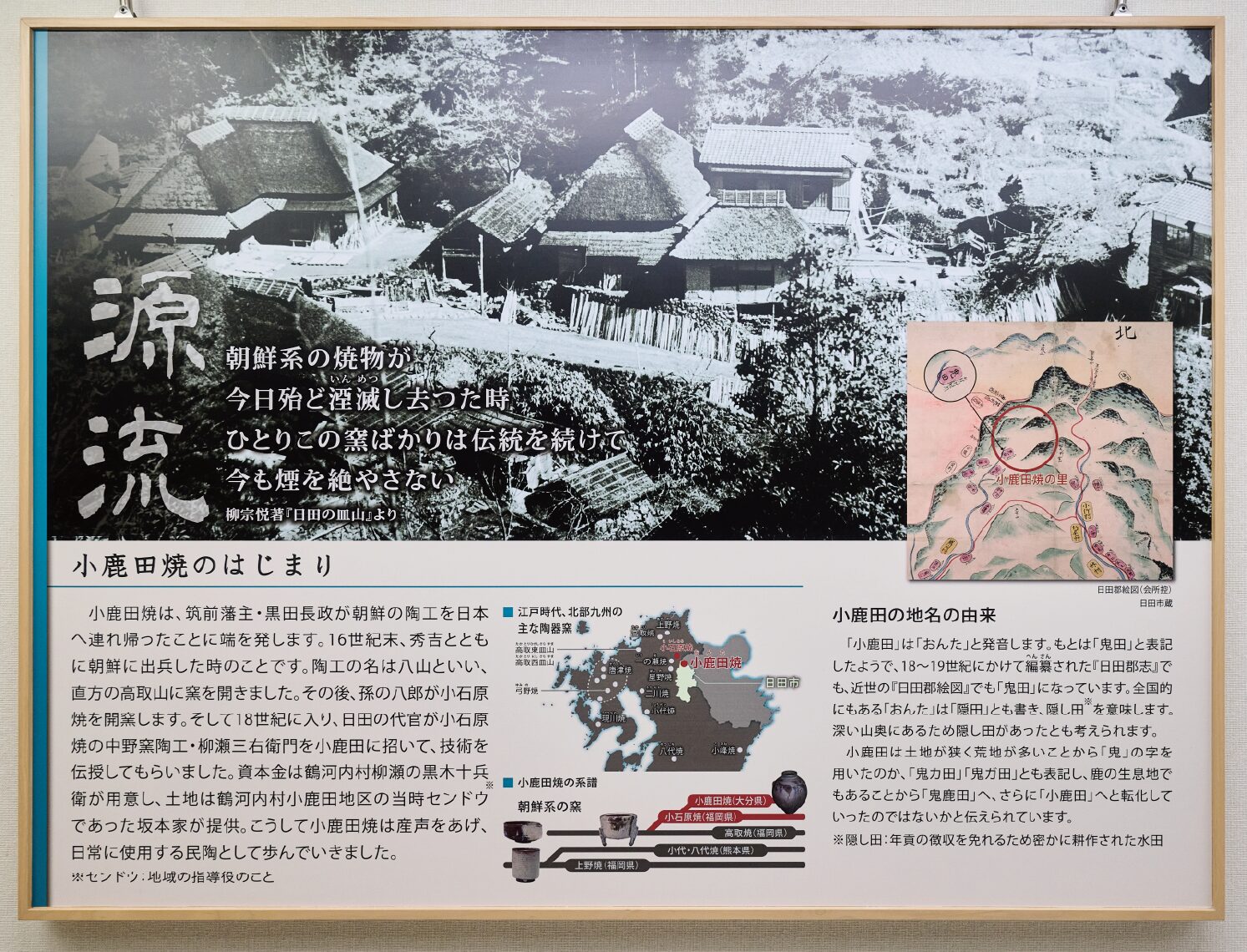
Origins
When Korean-style pottery
had almost completely disappeared
this kiln alone continued the tradition
and smoke still billows from it today.
The Beginnings of Onta Pottery
Many Korean potters came to Japan In the late 16th century, this led the opening of kilns all over Kyushu. Takatori-yaki and Koishiwara-yaki also began in Fukuoka.
Early 18th century, Hita magistrate invited a potter named Yanase Sanemon from Koisiwara to Onta, and taught his techniques. At the same time, Kuroki Jyubei provided the capital for the pottery business, Local leaders the Sakamoto family provided the land. That was the history of folk pottery began of Onta-yaki.
The origin of the name “Onta”
Early people was calling this village as “鬼田(onta)=demon`s field”, meaning deep in the mountains like inhabited demons.
But “demon’sfield” make scary impression, since after people changed the area name as
“小鹿田(onta)=fawn’s field”, it make a cute impression.
Now in autumn, we heard the cry of fawns and deer through the mauntains.
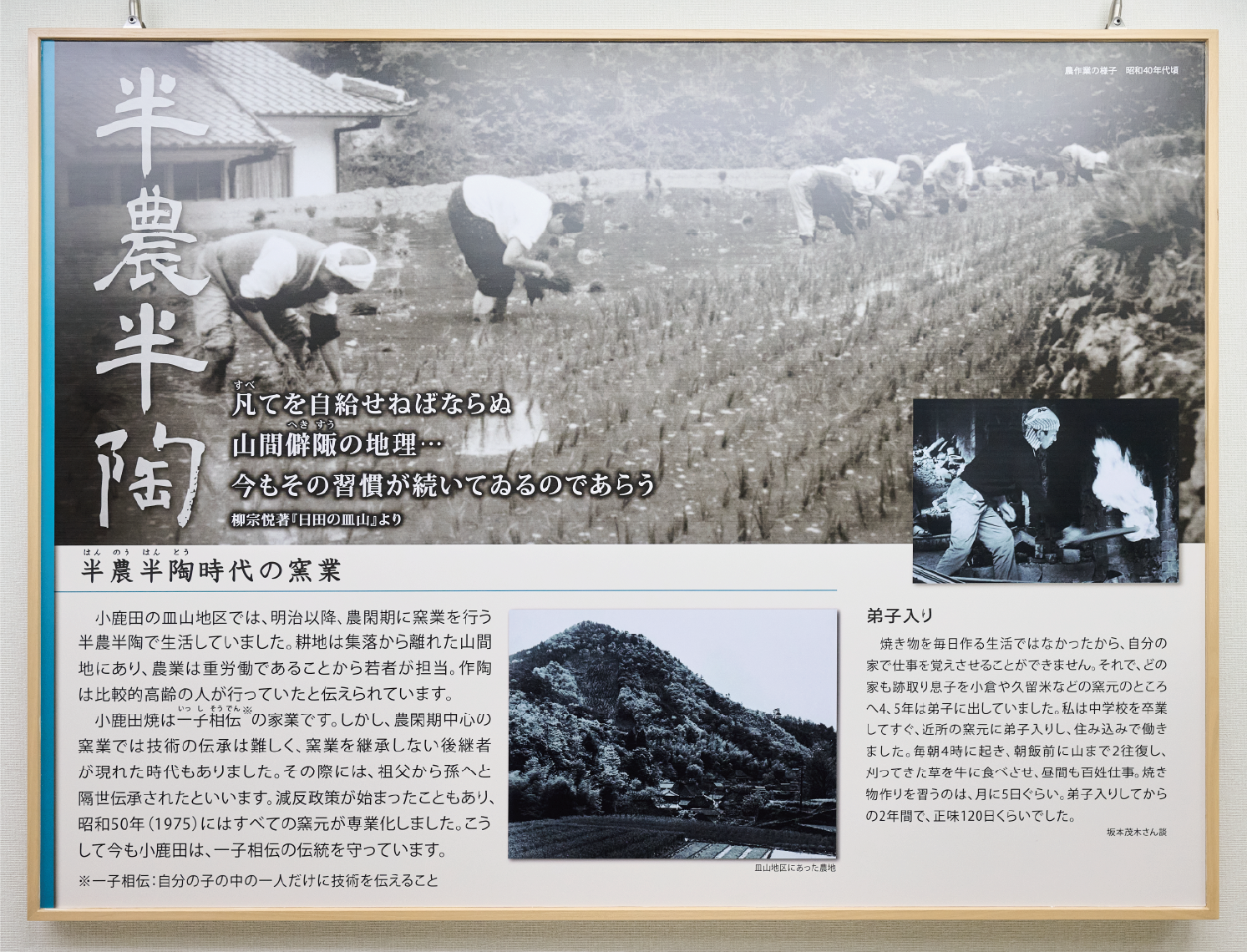
Half farmer, half potter
Everything must be self-sufficient,
in this remote mountainous geography…
This custom probably continues to this day
Pottery in the half-farmer,
half-potter era
In the Sarayama district, people have lived as half-farmers, half-potters since the Meiji period, engaging in pottery during the agricultural off-season. Farmland was located in mountainous areas away from the village, and agriculture was physically demanding work, so young people took on this role. Pottery was traditionally carried out by older individuals.
Onta pottery is a family business passed down through the male line (isshiso-den). However, with pottery production centered around the agricultural off-season, passing down techniques became difficult, and there was a time when no successors emerged to carry on the craft. In such cases, it is said that the techniques were passed down from grandfather to grandson, skipping a generation. Additionally, with the implementation of the rice production reduction policy, by 1975 (Showa 50), all pottery workshops had specialized in pottery production. Even today, Onta continues to uphold the tradition of passing down the craft through the “isshisoden”※ system.
※Isshōsōden: Passing down techniques to only one of one’s children.
Apprenticeship
“Since daily pottery production was not a way of life, it was impossible to learn the trade at home. Therefore, every household sent their heir to a pottery workshop in Kokura or Kurume for four or five years as an apprentice. I graduated from middle school and immediately became an apprentice at a nearby pottery workshop, living and working there. Every morning at 4 a.m., I would wake up, make two trips to the mountain before breakfast to feed the cows the grass I had cut, and work on farm tasks during the day. I only learned pottery-making about five times a month. In the two years after becoming an apprentice, I worked a total of about 120 days.”
Sakamoto Shigeki’s account
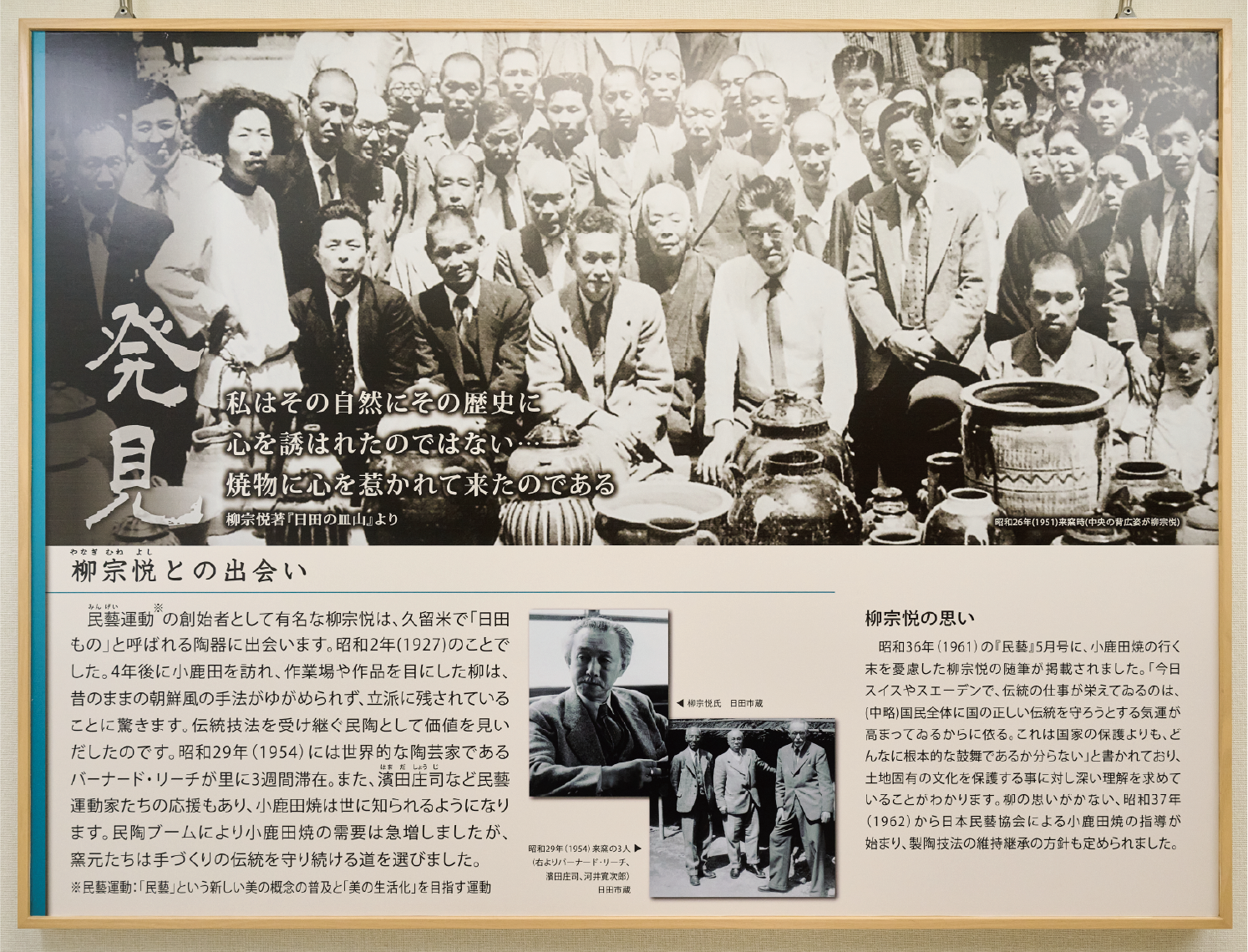
Discovery
It was not the nature or history that
captured my heart…
It was the pottery that drew me in.
My encounter with
Yanagi Soetsu
I Yanagi Soetsu famous as the founder of the Mingei (folk art) movement, encountered pottery known as “Hita-mono” in Kurume. This was in 1927.
Four years later, when he visited Onta, he was amazed to see that the traditional Korean-style techniques had been preserved intact. He recognized the value of these pottery pieces as examples of folk pottery that had inherited traditional techniques. In 1954, Bernard Leach, a world-renowned potter, stayed in the village for three weeks. With the support of folk art movement activists such as Shoji Hamada, Onta-yaki became known to the world. Although demand for Onta ware skyrocketed due to the folk pottery boom, the kiln owners chose to continue their traditional handmade methods.
※Mingei: A movement that aims to spread a new concept of beauty called
“mingei and to “make beauty a part of everyday life.”
Yanagi Soetsu’s thoughts
In the May 1961 issue of “Mingei,” Yanagi Soetsu published an essay expressing his concerns about the future of Onta-yaki. He wrote, “Today, traditional crafts thrive in Switzerland and Sweden because there is a widespread desire among the people to preserve their country’s true traditions.”
This is a far more fundamental inspiration than any form of state protection.” This passage reveals Yanagi’s deep understanding of the importance of preserving local culture. Yanagi’s vision was realized, and in 1962, the Japan Folk Crafts Association began providing guidance for Onta-yaki, establishing policies for the preservation and transmission of traditional pottery techniques.
Bernard Leach and Onta-yaki
British potter Bernard Leach (1887-1979) visited Onta for the first time in April 1954, along with Japanese potters Hamada Shoji and Kawai Kanjiro.
During his approximately three-week stay, Leach conducted pottery research, provided guidance to potters, and deepened his friendships with the villagers.
Ten years later, in 1964, Leach returned to the village and was delighted to find that the traditional methods of pottery making, including the sound of the ‘唐臼’ (a traditional mortar used to crush clay) and the harmony between nature and pottery, remained unchanged. He expressed his hope that this pottery village would be preserved forever.
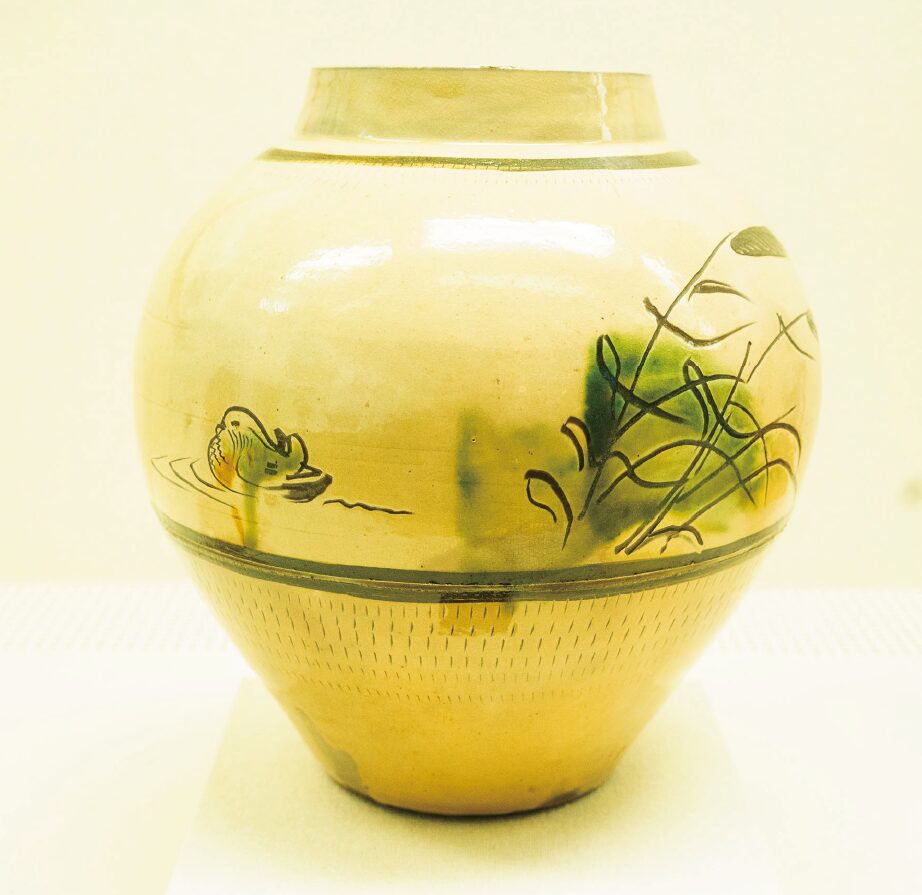
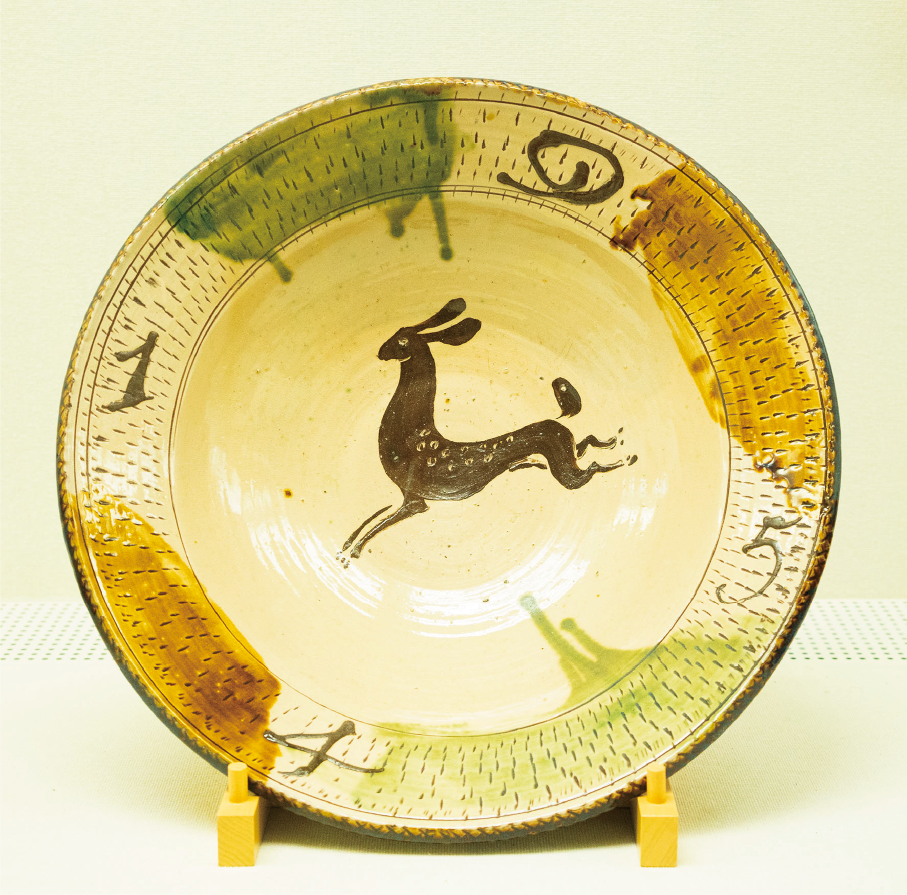
The pottery museum displays two works created by Leach during his 1954 stay: a ‘jar’ and a ‘deer-patterned large plate.’
These two pieces feature unique depictions of plants and animals, along with the chattering design characterizeed fo Onta pottery.
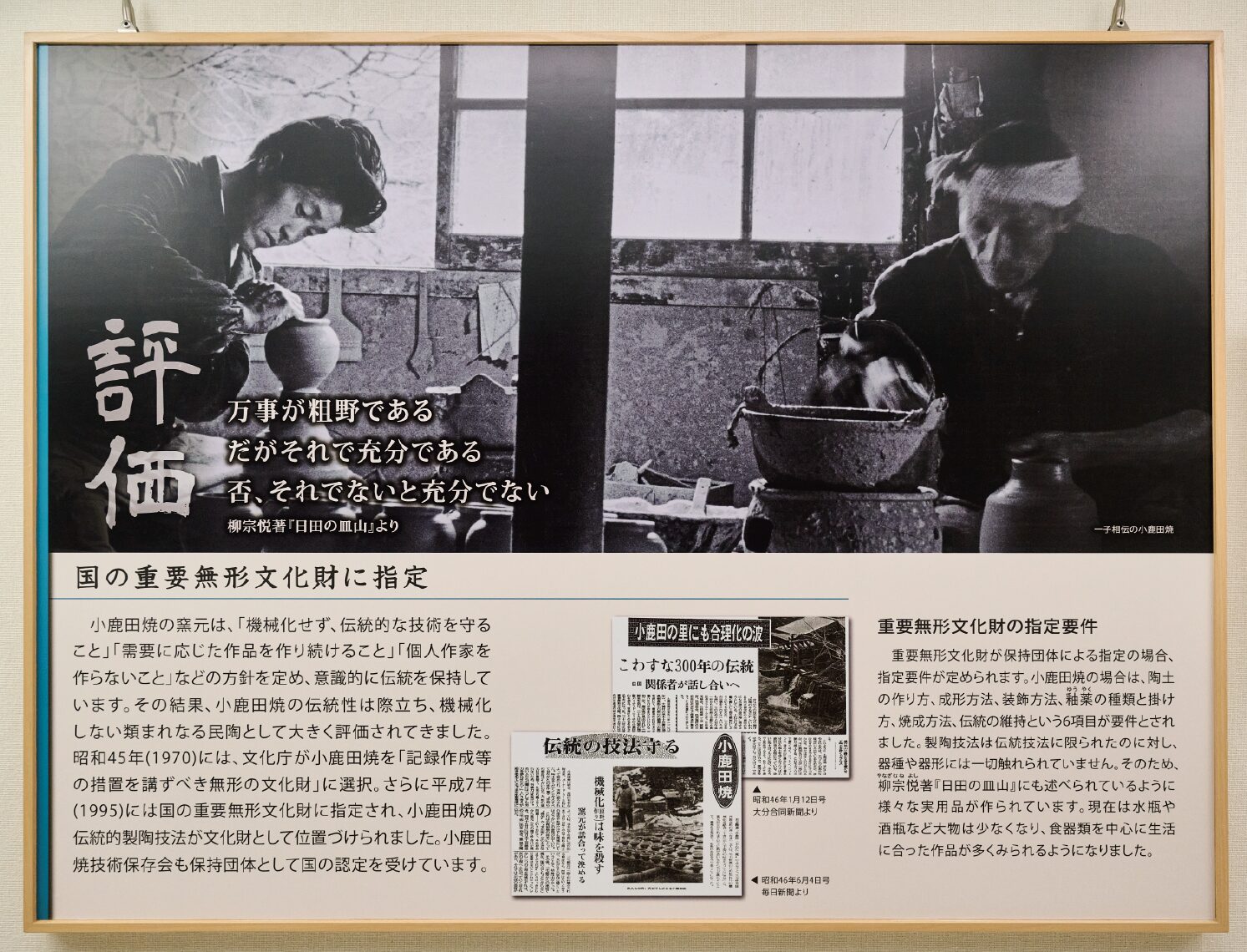
Evaluation
Everything is unpolished
But that is enough…
In fact, without that roughness, it wouldn’t be enough.
Designated as an Important Intangible Cultural Property of Japan
The kilns of Onta-yaki have established guidelines such as “not mechanizing”, “preserving traditional techniques,” “continuing to produce works according to demand,” and “not fostering individual artists,” and consciously maintaining tradition. As a result, the traditional nature of Onta-yaki stands out, and it has been highly evaluated as a mechanized rare folk pottery. In 1970, the Agency for Cultural Affairs selected Onta-yaki as an “intangible cultural property requiring measures for record-making and other preservation efforts.” In 1995, it was designated as an Important Intangible Cultural Property of Japan. The Onta -yaki Technical Preservation Society has also been recognized by the government as a preservation group.
Criteria for Designation as an Important Intangible Cultural Property
When an Important Intangible Cultural Property is designated by a preservation group, specific criteria must be met. In the case of Onta-yaki, the criteria include six items: the method of preparing the clay, shaping techniques, decorative methods, types of glaze and application methods, firing techniques, and the maintenance of traditional practices. While the pottery techniques are limited to traditional methods, there are no restrictions on the types or shapes of vessels. As mentioned in “Hita no Sarakayama” by Yanagi Soetsu, a variety of practical items are produced. Currently, large items such as water jars and sake bottles have become less common, and works centered on tableware that suit modern lifestyles are now more prevalent.
Characteristics of Onta yaki
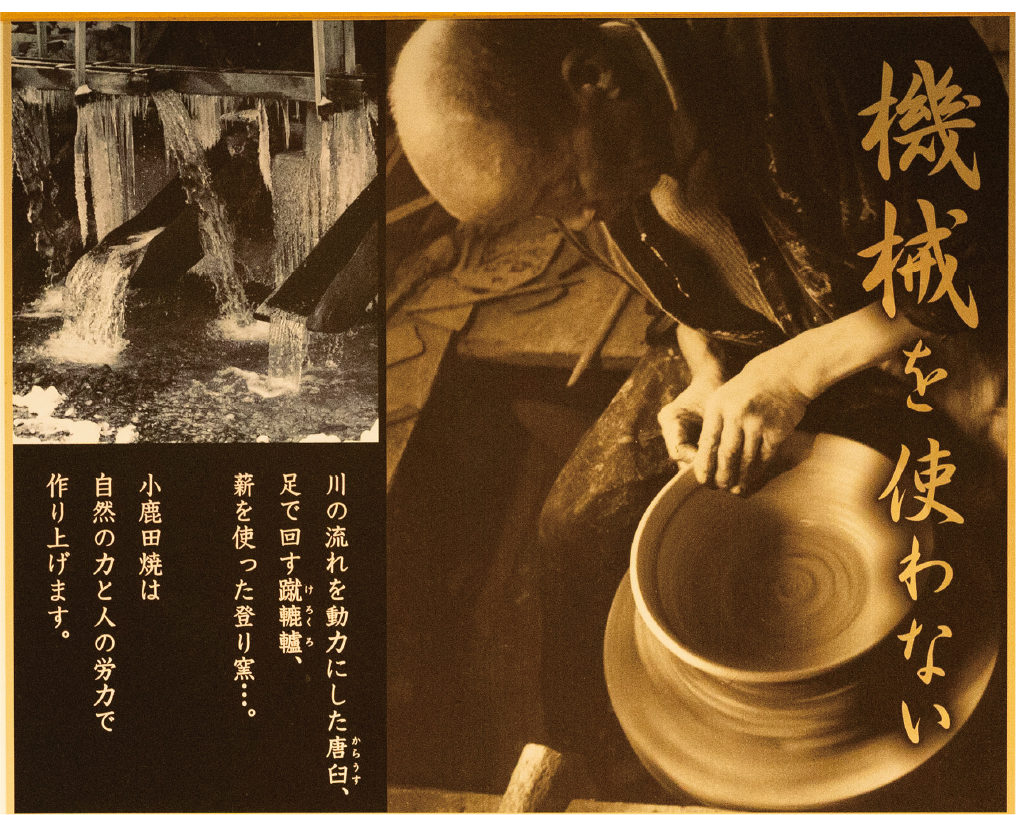
No machinery is used
The Karausu powered by the flow of the river, kick wheel,
and the climbing kiln…
Onta-yaki is created using the power of nature and human labor.
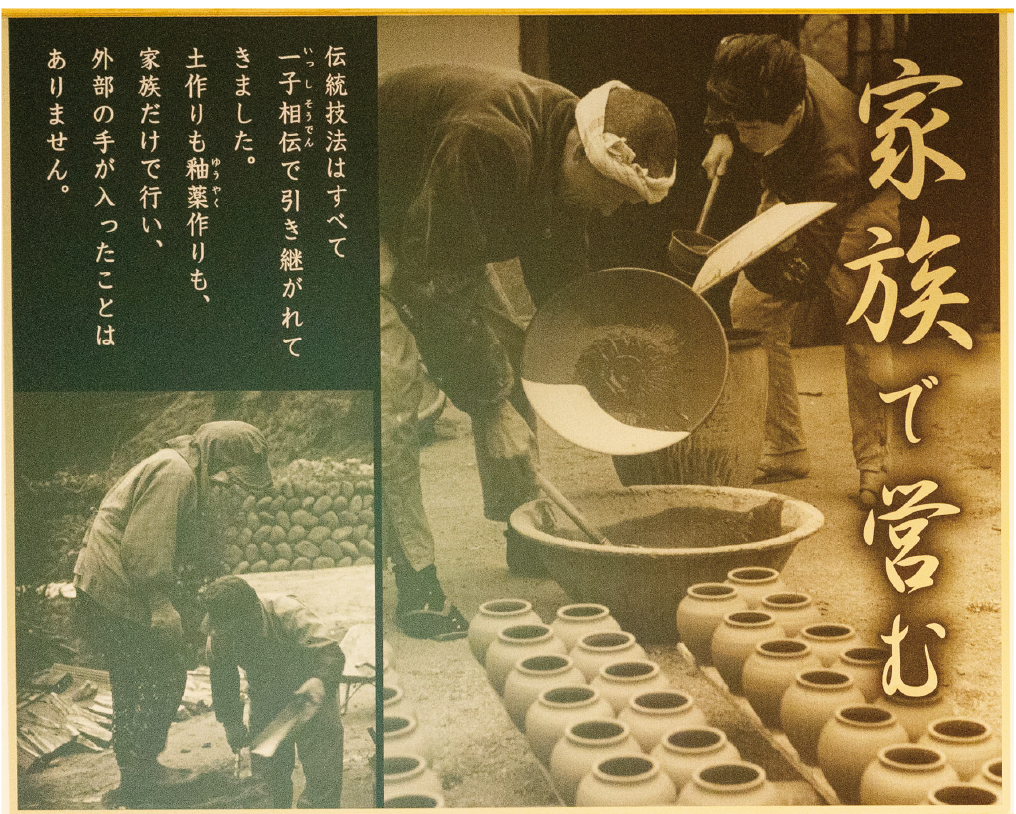
Family-run
All traditional techniques have been passed down from father to son.
The family does all the work themselves, from making the clay to applying the glaze, without any outside help.
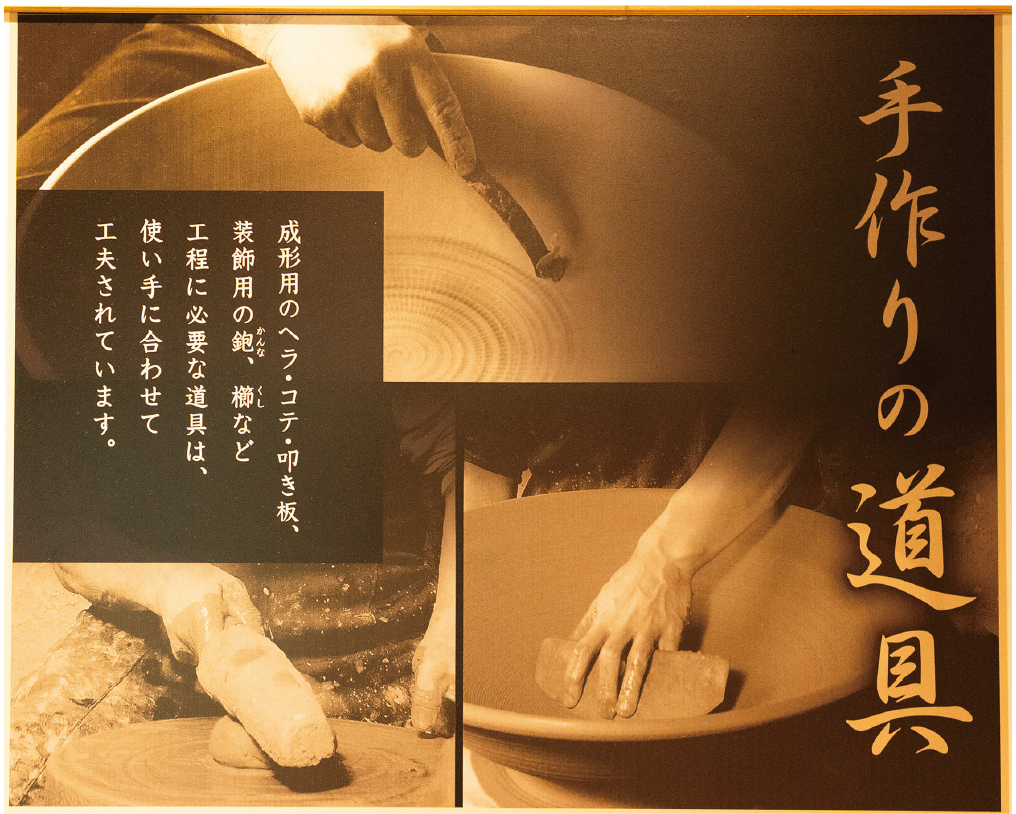
Handmade tools
Spatulas, scrapers, and mallets for shaping, planes and combs for decoration, etc.
The tools required for each process are carefully selected and customized to suit the user.
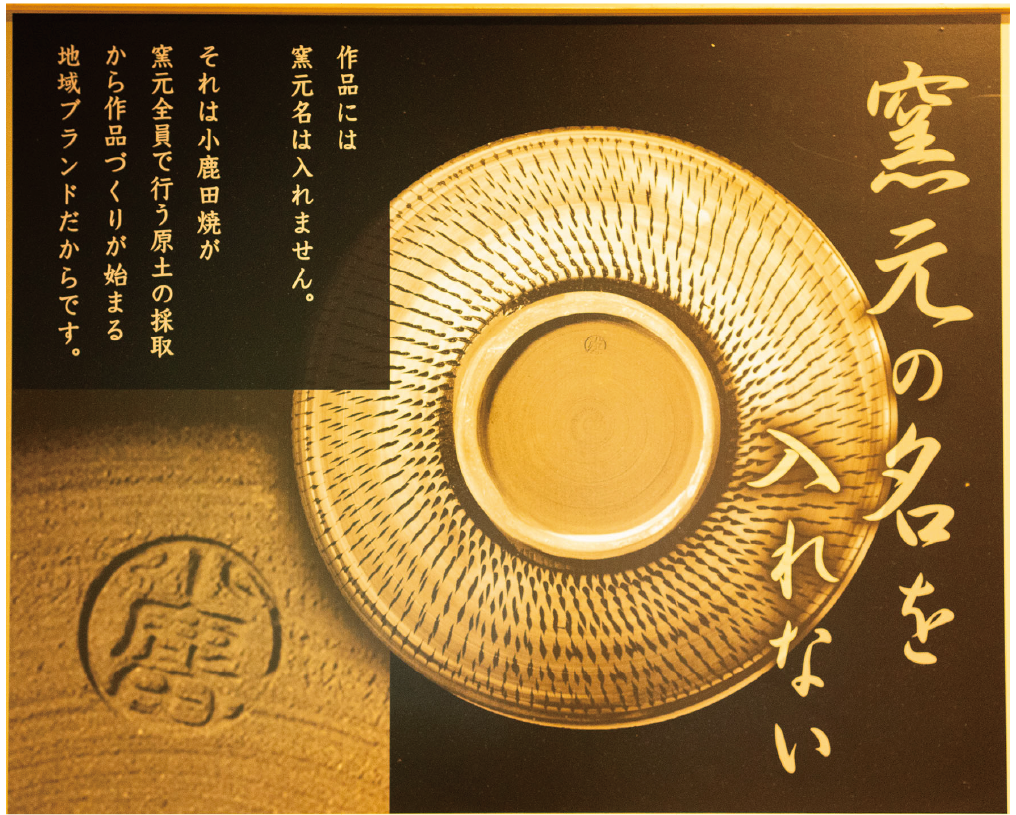
Do not include the name of each kiln owner
The Each kiln owner doesn’t sign their works.
This is because the creation of Onta yaki begins with the collection of raw clay by all the kilns in the region and is a regional brand.
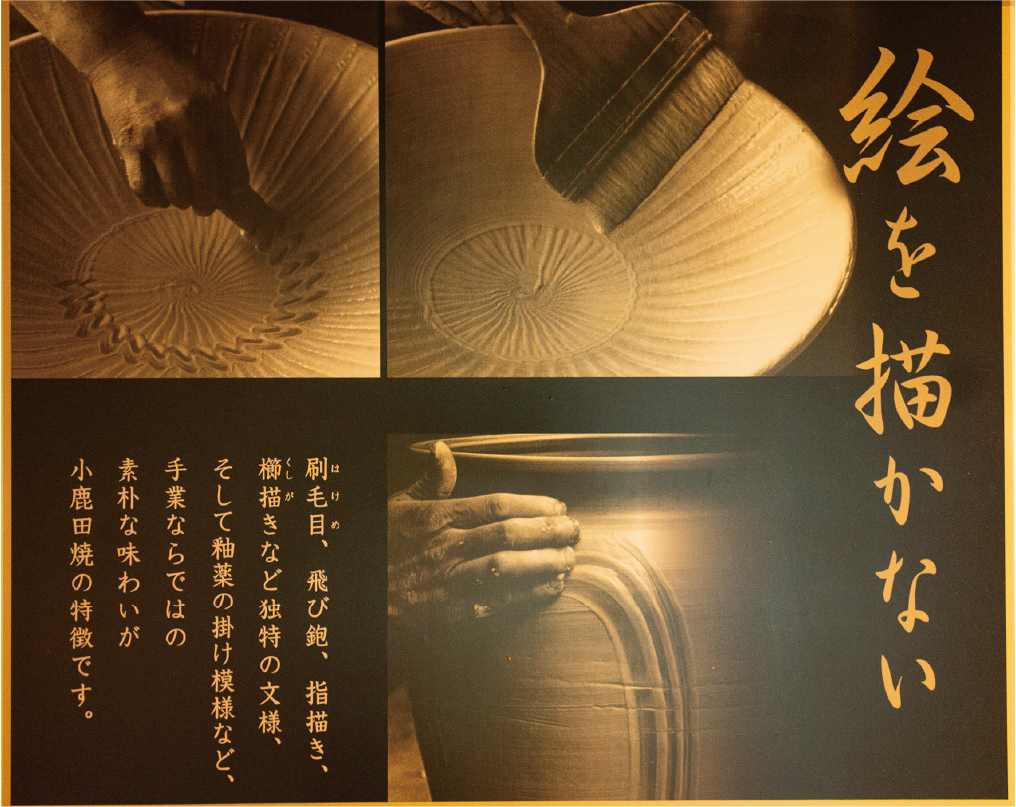
No painting
Unique patterns such as brush strokes, chattered design called tobikanna, finger painting, and comb painting,
as well as glaze patterns, are the simple, handmade charm that characterizes Onta yaki.
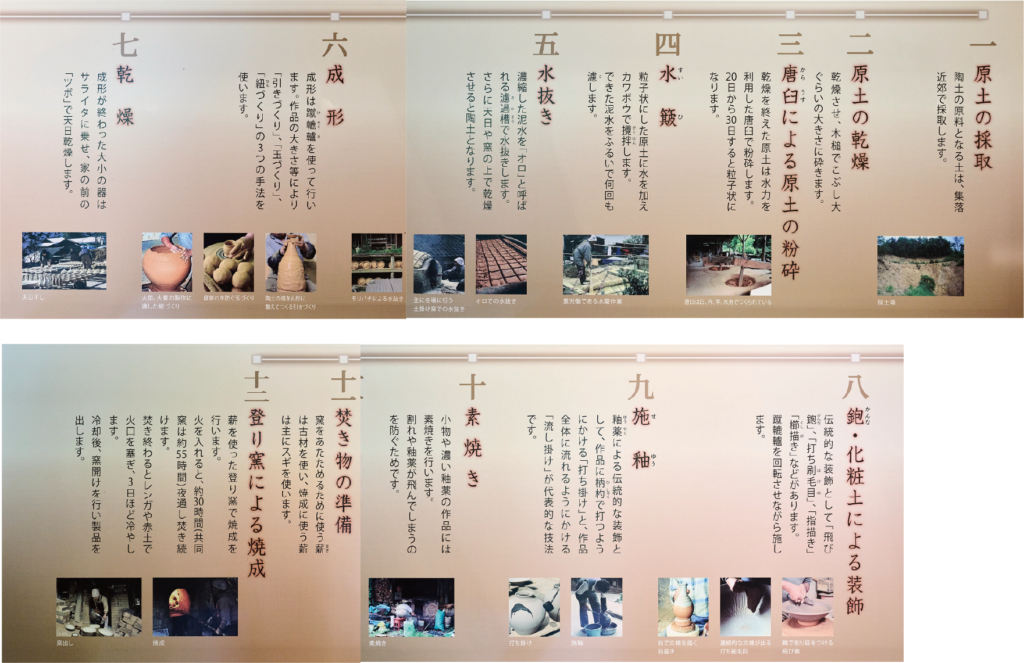
The process of making Onta yaki
1. Raw clay intake
2. Drying the raw soil
3. Crushing raw soil with a Karausu
Once the raw soil has been dried, it is crushed using a mortar powered by water.
After 20 to 30 days, it becomes granular.
4. Watering
Add water to raw soil finely ground to particles, and stir with a wooden spoon.
Filter the resulting muddy water several times with a sieve.
5. Water removal
The concentrated muddy water is drained through a filter layer called ‘oro.’
It is then dried in the sun or on top of a kiln to become clay.
6. Moulding
Moulding is performed using a kick wheel. Depending on the size of the piece,
three techniques are used: ‘pull moulding,’ ‘ball moulding,’ and ‘string moulding.’
7. Drying
8. Decorations
Traditional decorations include ‘ chattering (tobi-kannna), ‘brush strokes’ (hakeme), ‘finger painting’ (yubikaki), and ‘comb strokes’ (kushi-gaki).
Applied while rotating the potter’s wheel.
9. Glaze
Traditional decorative techniques using glaze include ‘uchikake,’ in which the glaze is applied with a ladle, and ‘nagashi-kake,’ in which the glaze is poured over the entire piece.
10. Bisque firing
Bisque firing is performed on small items and pieces with thick glaze.
This is to prevent cracking and glaze from flying off.
11. Preparing the firewood
12. Firing in climbing kiln
Firing is carried out in wood-fired climbing kilns.
Once the fire is lit, it is kept burning continuously for
approximately 30 hours (55 hours for a shared kiln) throughout the night.
After cooling, the kiln is opened and the products are removed.
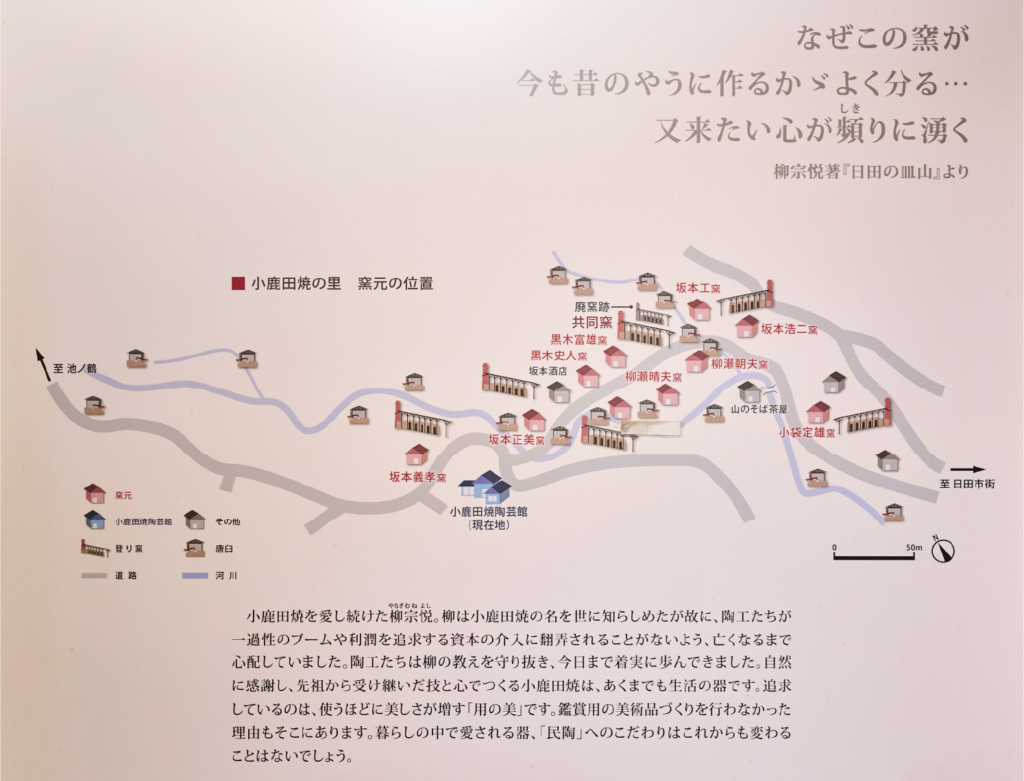
Why this kiln
I can really understand why this kiln still makes things the way it did in the old days…
Again and again, the feeling wells up inside me that I want to come back.
From “Hita no Sarayama” by Yanagi Soetsu
Yanagi, who brought the name of Onta-yaki to the world, was deeply concerned until his death that the potters would not be swayed by fleeting trends or the pursuit of profit by capital. The potters have steadfastly upheld Yanagi’s teachings and continued their craft to this day. Onta-yaki, created with gratitude toward nature and the techniques and spirit passed down from ancestors, is ultimately a vessel for daily life. What they pursue is the “beauty of utility,” where beauty increases with use. The reason they did not create decorative art pieces lies in this philosophy. Their dedication to “folk pottery,” vessels cherished in daily life, will likely remain unchanged in the future.